
Operations for founder-led businesses
A business that runs beyond your inbox.
We fix one core operation in 90 days, so every order, deliverable, and approval no longer needs you. Built into your tools. Handed to your team.
For agencies, D2C brands, and tech-enabled service teams.
Start with a paid, 90-minute Teardown. Keep the written report.
See pricing & engagement optionsToday Client delivery
Every decision waits in your inbox.
Designed to run with your team
Brief captured
One clear place for every brief
Owner assigned
A clear next step and due date
Quality checked
Your standard, written into the workflow
Track approval time, overdue work, and founder escalations.
One operation. A scope agreed up front.
Your tools. Software and documentation you own.
Your team. Training and a warranty after handover.
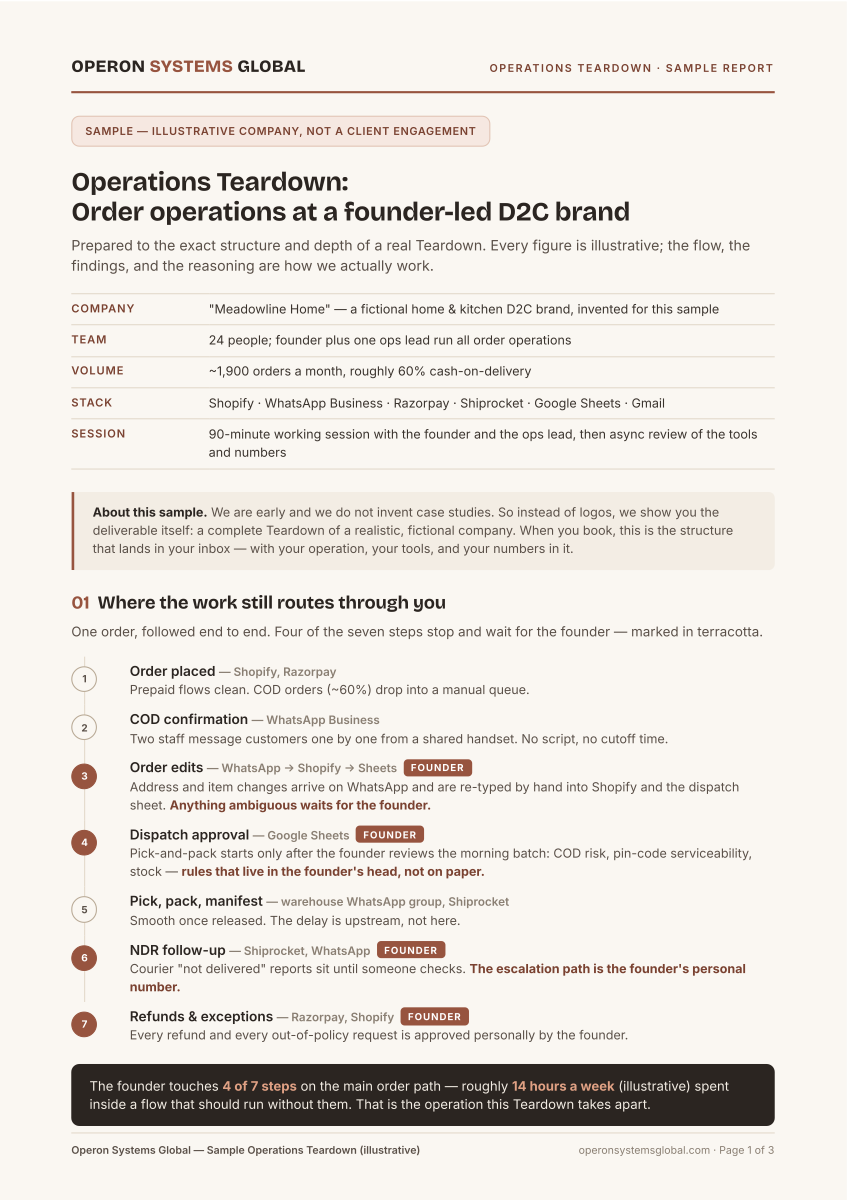 View sample PDF
 See the work before you commit
A concrete report. A clearer next decision.
Your Teardown maps one operation, identifies where it breaks, and sets out what to fix first. You keep the report whether or not we build together.
- 01 The operation map and its bottlenecks
- 02 Findings, priorities, and the cost of the problem
- 03 A proposed scope, measurable target, and fixed price
This sample is illustrative, not a client engagement or evidence of achieved results.
Explore what you receiveSound familiar
Agency
Every project routes through your inbox. Approvals, revisions, client escalations — the team moves when you move, and stalls when you can’t.
D2C brand
Orders keep growing. Ops is still spreadsheets, WhatsApp threads, and one person who knows how the whole thing actually works.
Tech-enabled services
Delivery quality lives in the founder’s head. Every new hire is trained by hand, and every handoff dilutes the standard a little more.
If fixing this just became your job — whether you’re the founder or the person the founder handed it to — this page is for you.
How you’d work with us
One path. Three steps. You can stop after any of them.
No open-ended retainer, no black box. You start small and paid, you see the win before you commit to the next step, and everything we build is yours to keep.
All prices exclude applicable taxes; GST is charged additionally as per law. International prices exclude taxes; you may owe reverse-charge VAT/GST in your jurisdiction.
Step 1
Operations Teardown
₹50,000. Credited in full against a First Win engagement.
We take apart one operation that’s costing you time or money and show you exactly where it breaks and what fixing it is worth. You leave with a written teardown report whether or not we work together.
The cheapest way to find out if we’re right.
Step 2
First Win in 90 Days
₹3–4L·Founding rate ₹1.5–2L
2 founding slots · in exchange for a documented case study + reference · steps up after.
We fix one core operation end to end in 90 days — scoped up front, with a clear line on what’s in and what’s out.
Guarantee: We co-define the measurable win up front. Miss it, and the final tranche is waived.
Step 3
Quarterly Wins
₹75K–1.5L / month·scoped each quarter
Once the first operation holds, we take the next one — one scoped win at a time. Not a retainer. Every quarter is defined, priced, and exit-able on its own.
What you keep
Everything we build runs on the tools you already pay for — Shopify, WhatsApp Business, Notion, ClickUp, Zoho, HubSpot, Slack, Razorpay, Google Sheets. When we’re done you keep the working software, the written documentation, a team trained to run it, and a warranty window in case something breaks. Built to leave.
If you’re comparing options
You’ve probably already looked at one of these.
Different needs call for different partners. Use these questions to compare the scope of each proposal, including ours.
| The option | What to evaluate |
|---|---|
A fractional COO | Useful for ongoing senior leadership and operational decisions. Ask whether hands-on implementation, documentation, and team handover are included. |
An EOS implementer | Useful for a shared management framework and meeting rhythm. Confirm who will build and maintain the workflows and software underneath it. |
An AI agency | Useful for a defined automation need. Check who owns process design, exception handling, monitoring, and adoption by your team. |
Operon | Designs the process, builds the tech into the tools you already run, proves it with your own numbers, and hands it to your team. The fix stays after we leave. |
A fractional COO
Useful for ongoing senior leadership and operational decisions. Ask whether hands-on implementation, documentation, and team handover are included.
An EOS implementer
Useful for a shared management framework and meeting rhythm. Confirm who will build and maintain the workflows and software underneath it.
An AI agency
Useful for a defined automation need. Check who owns process design, exception handling, monitoring, and adoption by your team.
Operon
Designs the process, builds the tech into the tools you already run, proves it with your own numbers, and hands it to your team. The fix stays after we leave.
There’s a method under this
Technology · Processes · People — run as one system.
Technology—the software that does the work, built into your stack, not a new platform to migrate to.
Processes—the documented way the work runs, so it doesn’t live in one person’s head.
People—your team, trained to run it, so the system holds when we’re gone.
How every engagement runs: map → design → build → prove → hand back.
Shopify · WhatsApp Business · Notion · ClickUp · Zoho · HubSpot · Slack · Razorpay · Google Sheets
Your stack, not ours.
Who you’d actually work with
The founders. Both in the room. Both build.
Utkarsh Vijay
Co-Founder & Technical Director
A founding engineer who ships software into messy, live production stacks — the kind with real orders, real customers, and no room to break things. He designs the fix and builds it into the tools you already run.
Snehojit Kumar
Founder & CEO
Runs the numbers and the stress-test: what to measure, whether the fix actually moved it, and where the process still leaks. Sharpened as an analyst at a top global bank.
We take at most two engagements at a time, staggered so each build gets our full attention in its heavy weeks. We run them on the same documented system we sell, and every artifact we build is made so it doesn’t need us. That’s the whole point: if the fix depended on us being around, we’d have failed at our own promise.
Before you book
The questions people actually ask.
How does the guarantee actually work?
Before the 90 days start, we agree in writing on one measurable win — a specific number, on a specific operation, by a specific date. If we miss it, the final payment tranche is waived. The full clause, including what counts as a miss and what client-side gaps void it, is published in plain language on our How we work page.
What happens if something breaks after you leave?
Every engagement includes a warranty window after handover. If something we built breaks in that period, we fix it — no new invoice. After the window, break-fix is available as a scoped, priced job. We build things to keep running without us, but we don’t disappear the day we hand over.
Why is the Teardown paid?
Because a paid teardown gets you our real attention and a real deliverable, not a sales call in disguise. It’s credited in full against a First Win engagement, so if you continue, it effectively costs nothing. And it’s the cheapest way for both of us to find out whether we’re the right fit before anyone commits to 90 days.
Why only two engagements at a time?
Because we’re actually building your systems, not renting you advice — and that only works with real focus. At most two clients, staggered so each build gets full attention in its heavy weeks: a deliberate cap, not a marketing line. The honest detail, including how we staff it, is on the how-we-work page.
What exactly do you build?
Concrete, working things on the tools you already run: an order-ops flow in Shopify and WhatsApp Business, a client-delivery pipeline in ClickUp or Notion, a lead-response setup in HubSpot or Zoho, a dashboard in Google Sheets your team actually reads, a monitored WhatsApp or voice agent inside the process. Plus the documentation and training so your team owns it.
How much of my team’s time does this take?
Less than running the broken version does. We do the building; your team’s involvement is focused — a weekly checkpoint, plus time from the one or two people who know the operation best. We design around your team’s real capacity, because a fix nobody has time to adopt isn’t a fix.
The way in
Start with a Teardown.
One operation, taken apart and priced out, with a written report you keep either way. It’s the cheapest way to find out if we’re right — and it’s credited in full if you go ahead.
We reply within 24 working hours.